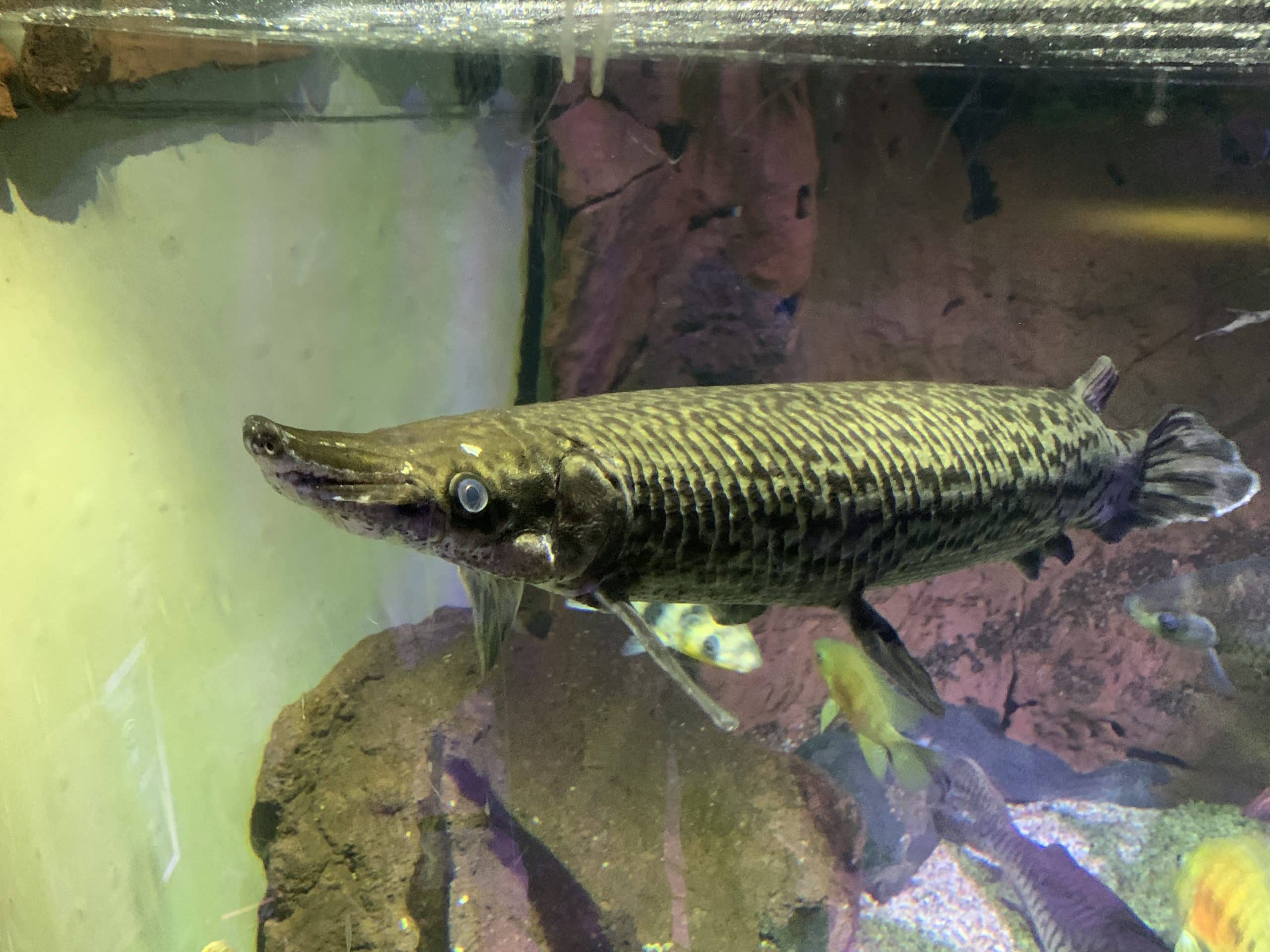
Despite taking its name from the popular reptile, the alligator gar is actually a huge fish. Let’s find out more about this distinctive looking species and where you can see it for yourself at Deep Sea World.
Introducing the alligator gar
The alligator gar (Atractosteus spatula) is the largest of seven gar species, and is actually the largest freshwater fish species in North America. Part of the Lepisosteidae family, they are related to bowfins.
They are a prehistoric species, first appearing over 150 million years ago, and for that reason they are often referred to as a living fossil. Over its time, it’s has survived largely unchanged, with their lineage being traced back to the dinosaur era.
Physical features and adaptations
The alligator gar is usually olive brown and covered in armoured scales. It has been known to grow up to 3 metres. It gets its name from the alligator-like head and jaws, which are very similar to the reptile. Alligator gars have a double row of teeth, and its dorsal and anal fins are positioned far back near the tail.
Alligator gars have a highly vascular air bladder that behaves like a lung, in order to pump air around its blood. This helps the fish to gulp air in order to breathe in water with low oxygen.
Native habitat and range
Gars are native to North and Central America, with alligator gars found throughout the Mississippi River Valley. They are known to live in the lower valley today, spanning the region between Oklahoma, Arkansas, Texas and Florida.
They prefer slow-moving rivers, swamps, marshes and large lakes, typically living amongst the backwaters. While they are freshwater fish, they can also tolerate brackish habitats if needed.
Hunting and diet
Alligator gars are ambush predators, typically floating motionless in water waiting for prey to swim within its range. Then, it will lung forward and move its head side to side to catch its prey with its teeth. They are also known to use a unique suction technique to suck prey into their mouths.
They are known as piscivores, meaning their diet consists mostly of fish. However, they are also opportunistic feeders and have been known to eat crustaceans, waterfowl and small mammals.
Conservation status
Globally, the alligator gar is classified as Least Concern on the IUCN Red List, but there are some instances in individual states where the populations are at risk. For example, they are threated in Illinois and endangered in Arkansas and Kentucky. Some of the biggest threats are habitat destruction and overfishing.
Quick fire facts about the alligator gar
Want to know more? Here are some extra facts about the alligator gar!
- Alligator gar eggs are highly toxic if ingested, as a defense mechanism against predators.
- They have diamond-shaped ganoid scales that are incredible tough and serve as a protective covering.
- Adult alligator gars have very few natural predators.
- They were first identified in the early 1800s.
Despite taking its name from the popular reptile, the alligator gar is actually a huge fish. Let’s find out more about this distinctive looking species and where you can see it for yourself at Deep Sea World.

Type
Fish

Size
Max 300cm

What do they eat
Fish, birds, small mammals and turtles

Water type
Fresh Water/ Brackish

Where are we
United States of America, Gulf of Mexico and Amazon

See Us At
Amazon