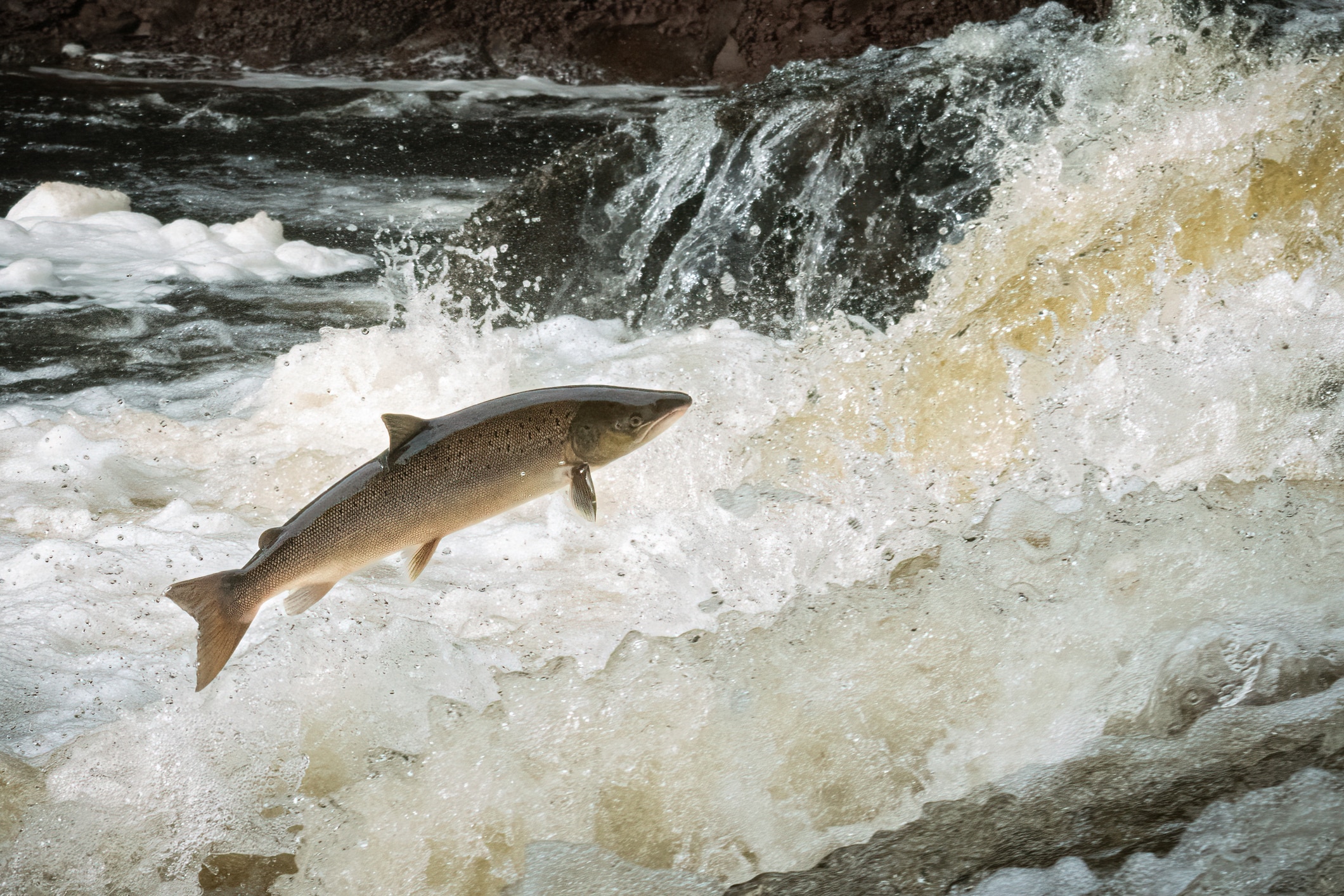
Salmon belong to the Salmonidae family and are sleek, powerful fish known for their migratory instincts. Split into two genera, the Pacific and Atlantic salmon, there are 7 species of Pacific salmon while there is only one species of Atlantic salmon. So, let’s learn a little more about this interesting creature.
Overview of the Atlantic salmon
The Atlantic salmon (Salmo salar) is a large species, growing up to around 75cm long. They are typically found in the cleanest rivers, and can be identified by their blue-silver colour with black dots along the back. Some also have a pink tone to their underside. They live amongst the temperate and arctic regions of the northern hemisphere, including off the coast of the UK.
Life cycle and migration patterns
Atlantic salmon are known as anadromous fish, which means they hatch and spend their juvenile years in streams and rivers but migrate out to sea. They return to their native freshwater streams to spawn.
Juvenile salmon, known as parr, will undergo a process called smoltification, where river-dwelling salmon develop salt tolerance in order to transition from freshwater to saltwater. They also turn predominantly silver for a more camouflaged appearance in the open sea waters.
It’s thought that salmon use the Earth’s magnetic fields like a map or compass, in order to navigate their way back to their native stream to spawn.
Quick-fire facts
So, what else is there to know about these fascinating fish? Here are some additional facts.
- Some subspecies of the Atlantic salmon are land-locked, residing in lakes and never making the migration.
- Atlantic salmon eat mostly small insects alongside smaller amphibians and fish during their juvenile stage, before eating a wider variety in the ocean such as other fish, crustaceans and cephalopods.
- Atlantic salmon are famed for their ability to leap across the water in order to travel upstream. They can jump up to 3 metres in order to overcome obstacles like waterfalls or weirs.
- During spawning season, male salmon will develop a hooked, elongated jaw known as a kype. This is to fight rival males and establish dominance in order to attract a female.
Atlantic salmon conservation status
Atlantic salmon are known as a keystone species, which means they have a significant impact on their environment. They help to transport nutrients from the ocean back into freshwater environments, as well as being a high-value food source for predators. Atlantic salmon can also help to report on the health of their ecosystems, as they require cold, clean water.
Currently, the IUCN Red List categorises Atlantic salmon as near threatened with a decreasing population. In the UK specifically, the species is endangered. The Atlantic Salmon Trust states that the population has declined by 70% in the last 25 years or so.
The major threats to the Atlantic salmon population include climate change, habitat degradation and migration barriers. By-catch can also contribute, as well as fish farming.
Salmon belong to the Salmonidae family and are sleek, powerful fish known for their migratory instincts. Split into two genera, the Pacific and Atlantic salmon, there are 7 species of Pacific salmon while there is only one species of Atlantic salmon. So, let’s learn a little more about this interesting creature.

Type
Fish

Size
Up to 75cm in length

What do they eat?
Insects, amphibians, fish, crustaceans and cephalopods

Water type
Both freshwater and saltwater

Where are we?
North Atlantic Ocean basin
