Learn all about Horseshoe Crabs and their History
Across the world, there are countless unique species of animals that are almost alien in their appearance. From the self-illuminating angler fish to the scales of the pangolin, evolution has always found a way to create creatures that are incredible at surviving and fascinating to look at.
One such animal is the horseshoe crab. While not a true crab, they have a striking resemblance to crabs, but are more closely related to arachnids like spiders or scorpions.
What are Horseshoe Crabs?
Horseshoe crabs are arthropods of the family Limulidae. They are found along the Atlantic coast of North America (from Maine to the Yucatan Peninsula) and along the coast of Asia on the sandy or muddy bottoms of shallow coastal waters, estuaries, and bays.
Their closest living relatives are arachnids such as spiders, scorpions and ticks, while they also share a link with the extinct Eurypterid (sea scorpions).
What do Horseshoe Crabs Look Like?
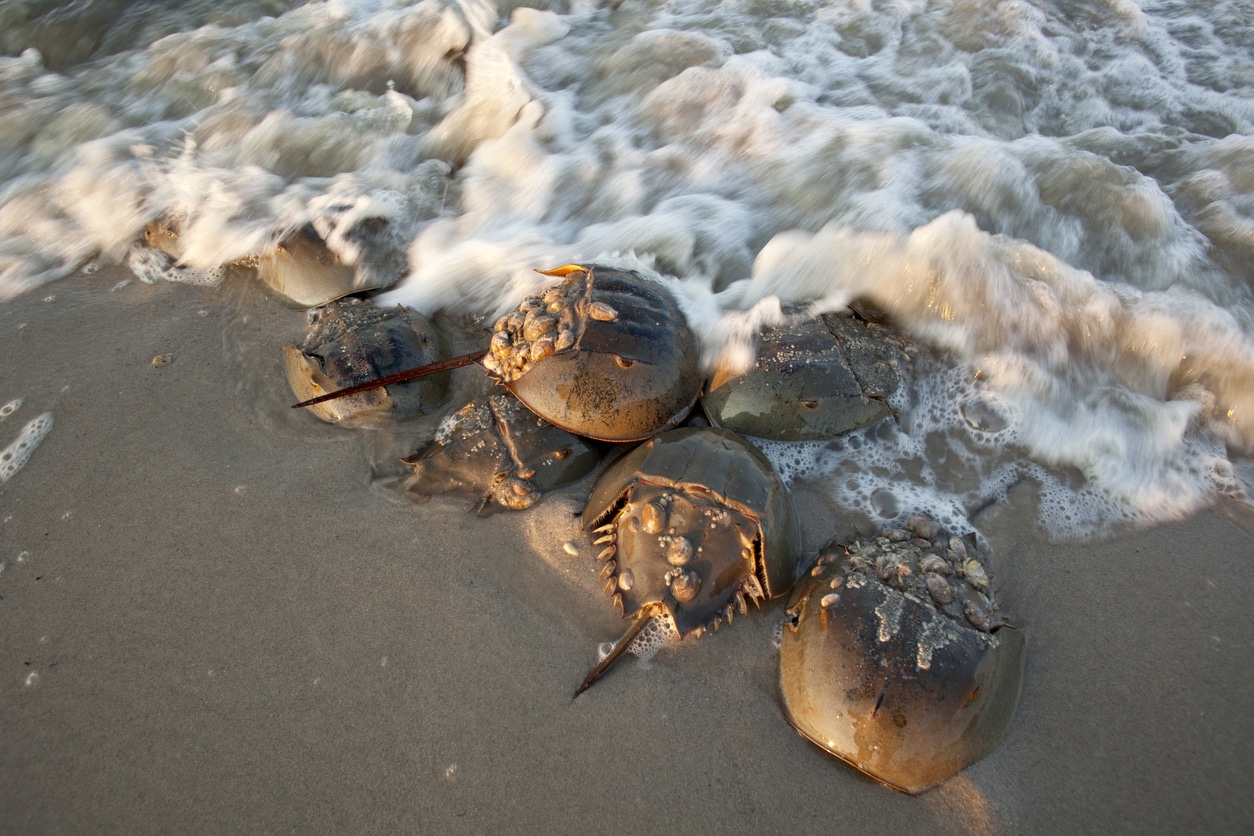
Horseshoe crabs are so named because of their distinctive, U-shaped front shell, known as the carapace, which closely resembles the shape of a horse’s hoof. The carapace is made of a tough, flexible material called chitin, which forms a hard exoskeleton to protect the horseshoe crab.
They have an incredible six pairs of legs, five used for walking and one pair used for feeding. Alongside their six pairs of legs, they also have five pairs of eyes!
Their body is tipped with a spiked tail that acts to support their body weight and flip them over if they get stuck on their back.

How Long Have Horseshoe Crabs Been on Earth?
Believe it or not, these incredible creatures have been around since before the dinosaurs! While the T. rex was still millions of years away, horseshoe crabs were already scuttling along the ocean floor. They have famously survived five mass extinctions. When the world changed dramatically, and other species vanished, the horseshoe crab just kept on going.
This is why scientists often call them living fossils. If you look at a fossil from 450 million years ago and compare it to a horseshoe crab today, they look almost identical. They haven’t felt the need to change or adapt much because their anatomy is already a masterpiece of survival. Their tough, tank-like shells and unique biology allow them to thrive in harsh, changing conditions that would spell trouble for almost any other animal.
Must-Know Facts About Horseshoe Crabs
Ready to dive deeper? These ancient wonders are full of surprises! Here are some of our favourite facts about the world’s toughest commuters.
They love a backstroke!
Did you know horseshoe crabs can swim upside down? While they usually spend their time crawling on the seafloor, they use their flapping gills to propel themselves through the water, often flipping over to glide along with ease.
Their blood is true blue
Unlike our red, iron-based blood, horseshoe crabs have bright blue blood! This is because it contains copper. Their blood is also incredibly special to humans; it contains a unique substance used by scientists to ensure medical equipment and vaccines are safe and bacteria-free.
The females rule the roost
In the world of horseshoe crabs, the females are significantly larger than the males. During the breeding season, you’ll often see a smaller male hitching a ride on the back of a larger female as she makes her way to the shore.
They’re coastal commuters
You won’t find horseshoe crabs in the deep, dark trenches of the ocean. They prefer shallow, coastal areas with sandy or muddy bottoms, making the shoreline the perfect place for them to forage and find a mate.

They can regrow lost limbs
If a horseshoe crab loses a leg to a predator or a rough tide, they have the amazing ability to regenerate it. Slowly but surely, the limb will grow back during their next moulting cycle.
They are record-breaking egg layers
During a single breeding season, a female can lay thousands of eggs in the sand. These tiny green eggs aren’t just important for the next generation of crabs; they provide a vital superfood for migrating shorebirds.
Meet the four species
There are only four living species of horseshoe crab left in the world today. The American Horseshoe Crab is found along the Atlantic coast of North America, while three other species reside in the waters around Indo-Pacific regions. Among them, the Tri-spine Horseshoe Crab is the largest of all four species.
Are Horseshoe Crabs Endangered?
While they’ve survived for millions of years, horseshoe crabs are currently facing their toughest challenge yet. They are considered threatened, with the American horseshoe crab officially listed as vulnerable by the IUCN.
They are under threat due to a combination of habitat loss, over-harvesting, and climate change. As we build more on our coastlines, the sandy beaches where they need to lay their eggs are disappearing. Additionally, because their blue blood is so valuable for medicine, many are collected from the wild.
Finally, rising sea levels and warming waters can disrupt their delicate nesting cycles. It’s a sure sign that we need to do more to protect these ancient survivors before they disappear from our coastlines for good.
Learn More at Deep Sea World
Want to get face-to-face with a real-life living fossil? At Deep Sea World, you can meet our very own American Horseshoe Crab! Seeing them up close is the best way to understand just how unique and hardy these creatures really are. You’ll learn about their prehistoric history and the vital role they play in our oceans today.
If you are ready for an underwater adventure, book your tickets now.


