A Guide to Seals: Fun Facts About Our Fin-Footed Friends
With their whiskered snouts and playful, inquisitive personalities, it’s easy to see why seals are often referred to as ‘the puppies of the ocean’. One of the most charming creatures found in our seas, these cute creatures come in all different shapes and sizes, with many different species to be found across the globe.
Looking to know more about just how amazing seals are? You’re in the right place – let’s dive in and take a closer look at where seals come from, their diet and behaviour, along with a chance to meet our own fin-footed friends right here at Deep Sea World.
What is a seal?
Seals are part of the order of marine mammals called pinnipeds, which also includes fur seals, sea lions (part of the Otariidae family) and walruses (part of the Odobenidae family), while seals are part of the Phocid family.
Seals are carnivores who use their streamlined bodies and four flippers to glide through the water in search of food. They’re typically found in colder regions of the earth, but a thick insulating layer of fat, called blubber, keeps them warm – even in arctic conditions!
Despite looking similar, seals shouldn’t be confused with sea lions. Sea lions can be identified by their visible ear flaps and their ability to “walk” on land using their large front flippers.
10 fun facts about seals you need to know
There are plenty of things that make seals fascinating creatures to admire. Here are just a few of them to garner your interest before you visit our seals.
There are 33 species of seal in the world
It might surprise you to know that there are 33 species of seal across the globe. They’re all large animals, found in colder conditions. There are significant variations in their fur colour, with seals further towards the poles requiring lighter fur to camouflage, and elephant seals have a trademark trunk, helping them to vocalise and retain moisture.
Seals live worldwide, commonly in ice-cold conditions
Common seals can be found around the coastal waters of both the Atlantic and Pacific Oceans. Despite their name, they’re actually rarer than the grey seals that often call the waters of the UK their home. You can tell the difference between the two from the common seals’ smaller size and shorter head, as well as their V-shaped nostrils compared to grey seals.
The majority of seals live in Arctic and Antarctic waters. While the freezing temperatures aren’t suitable for us, they’re perfect for seals whose fur and layer of fat-like blubber have adapted to such cold conditions over time.
Although seals are fantastic swimmers, they tend not to move very much when they’re on land, as they come out mostly for resting, but when they do, they move like caterpillars. This is called galumphing.

Seals are large animals
The smallest species is the Baikal seal (Pusa sibirica). This is the only exclusively freshwater pinniped and can only be found in Lake Baikal, Russia, and it still weighs up to 135kg.
On the other end of the scale is the southern elephant seal (Mirounga leonina). It can weigh up to 3,700kg and reach lengths of over 5 metres!
Fully grown males are usually bigger than the females. of the group and are incredibly territorial.
Seals are carnivores, dieting on fish, crustaceans and squids
Despite looking cute and cuddly, seals are skilled predators, hunting fish, crustaceans and squid. They use their streamlined bodies, alongside powerful flippers, their sensitive eyes and whiskers to detect movement before darting through the water, to catch unsuspecting prey. Seals do not hunt on land, instead using the land to rest, give birth, mate and moult.
Although we tend to think of seals as being harmless, the common variety is very skilled at preying on their food!
Seals store oxygen in their muscles
Like other marine mammals, seals are adept at storing oxygen in their muscles. By storing oxygen in their muscles and blood, rather than their lungs, seals can dive for between 30 minutes and two hours. This lets them look for all their favourite food, a real seafood platter of things like oily fish, squid and molluscs!
Seals swim on their backs for safety
To avoid being snapped up by predators like whales, seals frequently swim on their backs. This positional adjustment keeps their eyes facing down, giving them a better view of potential predators and prey.
Seals can be big sleepers
You can probably guess from a seal’s appearance that they’re a bit lazy. They like to bask in the sun and doze. Some days, seals will spend up to 10 hours per day sleeping when they are on land.
When they’re at sea, seals only tend to sleep for up to two hours per night, either floating on the surface of the water or by napping underwater for short periods.
Seals communicate through different sounds
True seals are known to communicate via grunting or snorting, but you might see sea lions barking, which is another way you can tell them apart. Elephant seals, for example, use their trunks to amplify their sounds, making them more dominant to shoo away predators and other males.
Much like human voices, seals’ vocalisations are unique to them, acting as an identifying feature to the herd.
Seals have their pups on land
The sea is a dangerous place for even adult seals, so they make use of their land-dwelling capabilities by giving birth on land. This allows the pups to be better protected from predators, feed more easily, and stay with their mothers.
They also only have one pup per pregnancy, allowing the mother to focus on the survival of just a single baby rather than several.

A group of seals is called a colony
Groups of seals, usually consisting of between 10 and 100 seals, are called a colony. Seals are incredibly social animals, so their connection to the herd is incredibly important.
When on land, they group together for protection and to conserve heat, meaning they use less energy to stay warm.
A group of elephant seals is referred to as a herd, just like a herd of elephants.
See seals at Deep Sea World
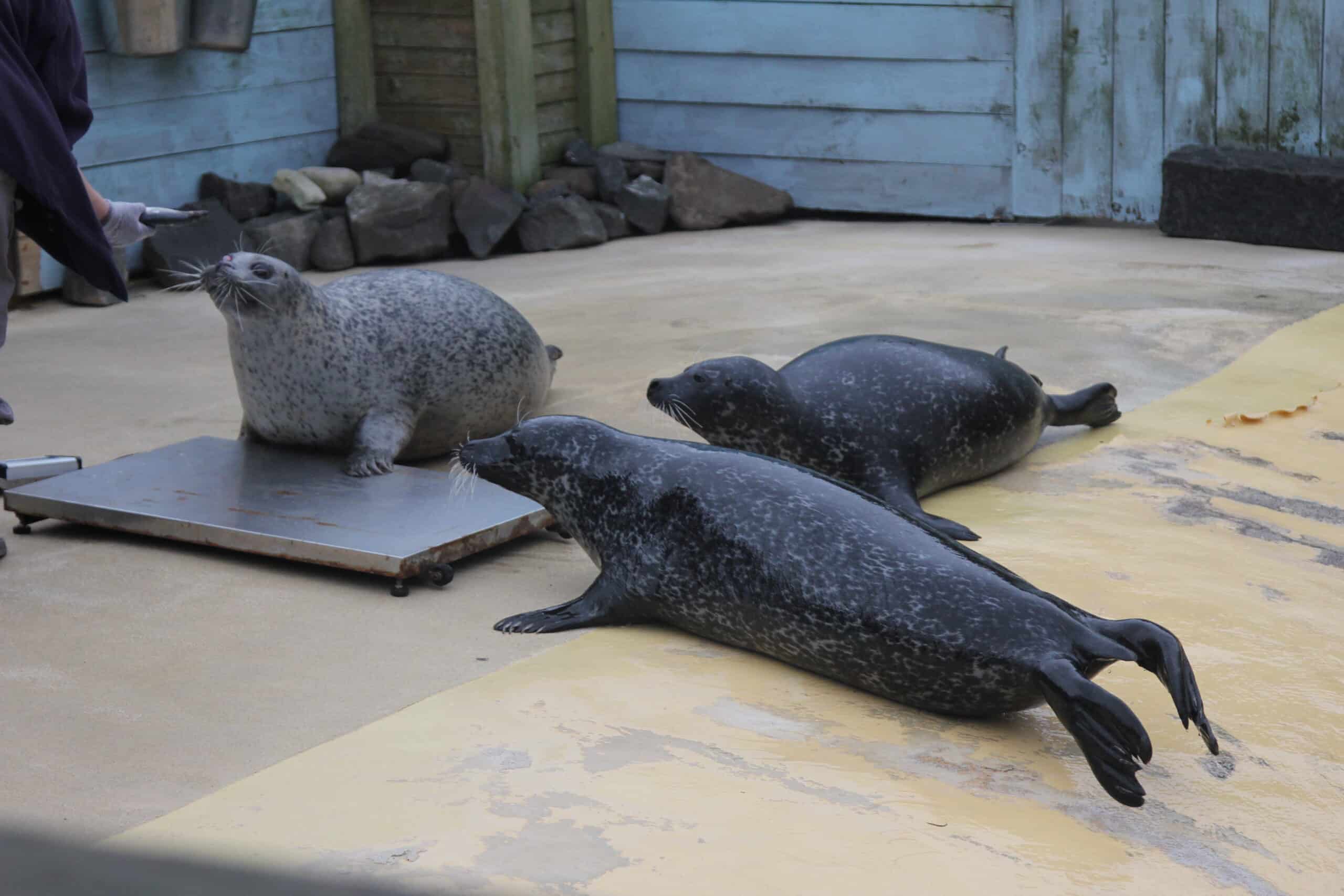
At Deep Sea World, our seals are some of our most loved members of the family. They’re adorable animals, absolutely bursting with personality. When visiting, you can watch them swim, play and show off their incredible natural behaviours.
Our team work with the seals every day, providing them with the best care they can receive through mental and physical stimulation.
Marvolo, or Marv, is the natural leader of our group of seals. He’s laid back but has natural authority and a confidence that the other seals respect. He’s also one our oldest seal.
Sofus is one of our most intelligent seals. He masters skills quickly and needs a steady stream of new tasks to keep him mentally invigorated.
Benji is a cheeky seal who prefers to learn at his own pace. At the moment, he’s mastering a behaviour to cover his nose, in a playful, “embarrassed” manner.
Cody is one of our most independent seals. He’s more than capable of learning new behaviours, but he prefers to explore and discover new things by himself.
We hope you enjoyed learning about our seals, remarkable marine mammals that are as playful as they are skilled. At Deep Sea World, we’re passionate about their care, conservation, and sharing their stories with visitors.
Drop by to see our seals in action at our 11:30 and 15:00 daily seal feeds and discover more about the wonders of the ocean.


